Showing posts with label David Ogilvy. Show all posts

Sunday, February 10, 2013

The most important thing I learned from David Ogilvy

I never met David Ogilvy. But he had a great impact on my career.

Kenneth Roman reveals the most important thing we can all learn from David Ogilvy:
Being edited by Ogilvy was like being operated on by a great surgeon who could put his hand on the only tender organ in your body. You could feel him put his finger on the wrong word, the soft phrase, the incomplete thought. But he had no pride of authorship, and he could be quite self-critical. Someone found a personally annotated copy of one of his books in which he had written cross comments about his own writing: “Rubbish. Rot! Nonsense.” He would send his major documents around for comment, with a note: “Please improve.”

Thursday, May 17, 2012

Power Words

Copywriters--perhaps more than other wordsmiths and marketing professionals--are on the constant lookout for formulas. As Bob Bly writes,
I confess: I love copywriting formulas! Why? For two reasons.
First, the best formulas are simple, easy to remember and rapidly mastered. Knowing them can enable you to create copy that's twice as effective—in half the time.
Second, the reason they became formulas in the first place is that they work.
Some copywriters talk about using "power words" -- emotion-packed words that set off visceral reactions. They often cite a study by Yale University Psychology Department. But was there ever such a study? The Language Log blog has run a series investigating this alleged study:Yale University Researchers Reveal 12 Powerful Words To Increase Your Profits

Whether or not there ever was a Yale study, practitioners of the art of persuasion know there are words that are innately more persuasive.

Use them.

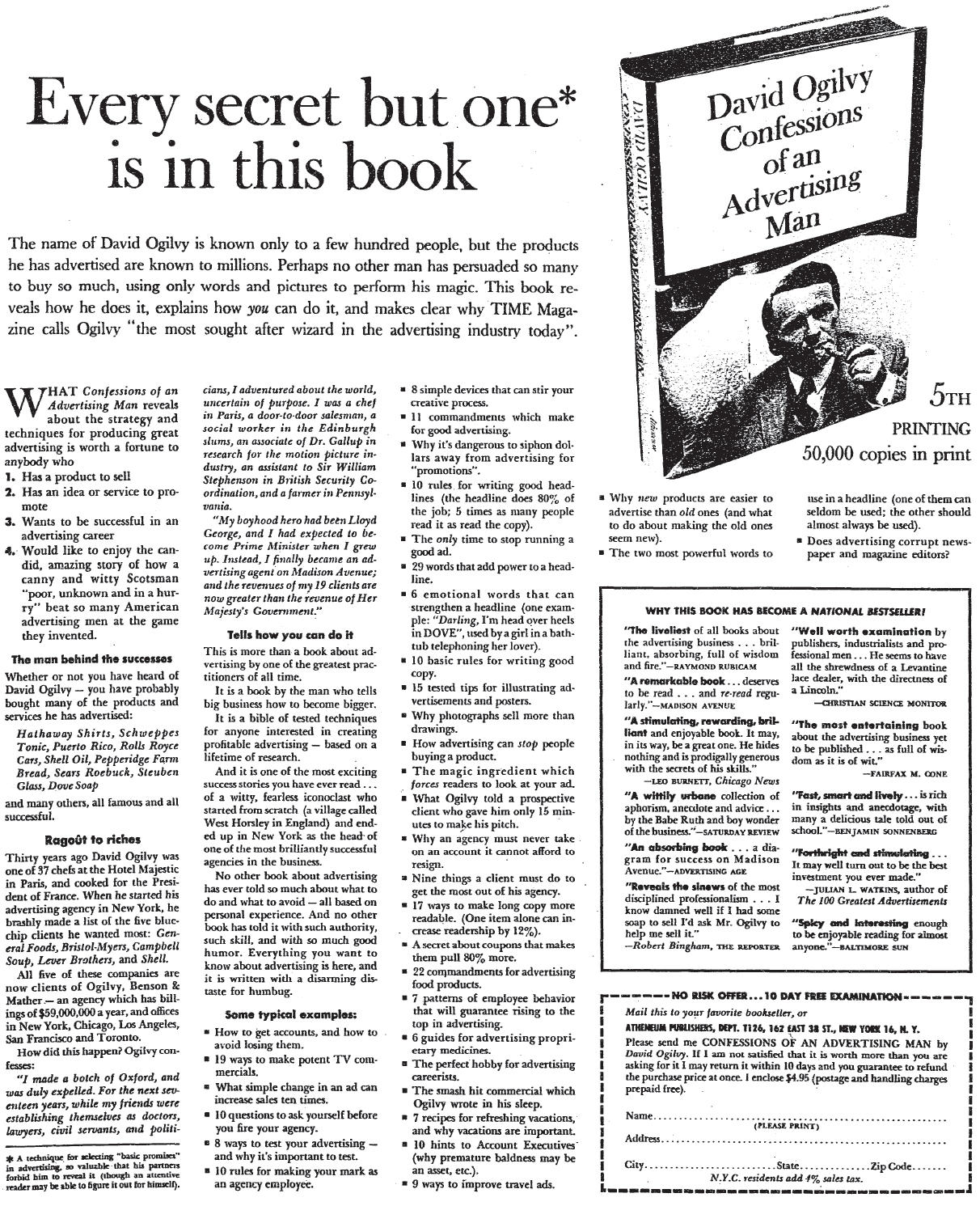
As David Ogilvy wrote in Confessions of an Advertising Man:
....words and phrases which work wonders are HOW TO, SUDDENLY, NOW, ANNOUNCING, INTRODUCING, IT’S HERE, JUST ARRIVED, IMPORTANT DEVELOPMENT, IMPROVEMENT, AMAZING, SENSATIONAL, REMARKABLE, REVOLUTIONARY, STARTLING, MIRACLE, MAGIC, OFFER, QUICK, EASY, WANTED, CHALLENGE, ADVICE TO, THE TRUTH ABOUT, COMPARE, BARGAIN, HURRY, LAST CHANCE.
   Don’t turn up your nose at these cliches. They may be shop-worn, but they work. That is why you see them turn up so often in the headlines of mail-order advertisers and others who can measure the results of their advertisements.
   Headlines can be strengthened by the inclusion of emotional words, like DARLING, LOVE, FEAR, PROUD, FRIEND, and BABY.

Wednesday, December 14, 2011

If they can't read it, they won't buy

Pardon me while I rant. One of my pet peeves is Un-Readability. (What do you feed a pet peeve?)

I have already written about the need to write readable, simple copy. (See "No Nonsense Copywriting." Also read copywriter Ryan McGrath's interview with me. For geeky information on analyzing text readability, see Flesch-Kincaid Grade Level Formula.)

But even if you write compelling copy, misguided design can make it impossible to read. And if they can't read it, they can't respond.

I've had pitched battles with brilliant graphic artists over layout and typography. I am not being sarcastic. In fact, the more brilliant and creative the designer, the more likely I am to have an issue. They tend to see words as design elements—rather than their design supporting the meaning of the words. 

I come from a tradition based on the word, not on images.

I have nothing against pretty. But as direct marketing consultant Paul Goldberg used to say about beautiful ads, "Pretty is as pretty does."

What really rankles me is when some graphic genius takes my carefully crafted copy, words I sweated over a hot keyboard for—to entice and influence—and makes them unreadable by using reverse type, or all caps, or some exquisite typeface that is lovely to look at, but impossible to decipher. (Remember the 1960's undulating psychedelic posters of Wes Wilson? Just reading them was a trip!)

Seeing my copy trapped in illegible type, I'd rant and fume, waving a copy of David Ogilvy's rules of typography. Sometimes I'd win. The problem was that Ogilvy's rules were based on ad results, not Art awards. We live in a world where Pepsi Cola spent over $1,000,000.00 for a logo redesign that looks barely different from their old one. Pepsi  declared the new logo "breathtaking" (I guess they were talking about the million dollars). In this atmosphere, any talk of ROI reeks of crass materialism. (I don't know anything about art. But I know what sells!)

Enter designer/typographer and journalist Colin Wheildon. In 1995, Wheildon published a study: Type & Layout: How Typography and Design Can Get Your Message Across—Or Get in the Way. Ogilvy was so impressed with the hard-nosed statistics backing his biases, that he wrote a foreword to the book:
If you write advertisements for a living, as I do, it is a matter of life and death that what you write should be read by potential customers. It’s the headline and copy that do the selling....The tragedy is that the average advertisement is read by only four per cent of people on their way through the publication it appears in. Most of the time, this is the fault of the so-called "art director" who designs advertisements. If he is an aesthete at heart—and most of them are—he doesn't care a damn whether anybody reads the words. He regards them as mere elements in his pretty design. In many cases he blows away half the readers by choosing the wrong type.
 In 2005, Wheildon published a new edition, with practical advice. Type & Layout: are you communicating of just making pretty shapes?

Get smart. Read the book. Look good. But sell.

Wednesday, November 23, 2011

Drayton Bird Copywriting Seminar

Drayton Bird is one of the pioneers of Direct Marketing--or as his partner David Ogilvy referred to it, "My secret weapon: Direct Response Advertising."

Ogilvy said Drayton Bird "knows more about direct marketing than anyone in the world. His book about it is pure gold. His speeches are not only informative, but hilariously funny."

Now Bird is making an irresistible offer on his three-hour seminar on copywriting on DVD. (Disclosure: I am not an affiliate and get no commission from this. I'm just a fan.)

So get this while the getting is good:Drayton's Copywriting Seminar DVD

Tuesday, November 22, 2011

David Ogilvy on Direct Response Marketing

In 1974 I bought a copy of David Ogilvy's Confessions of an Advertising Man in a used paperback shop in Jerusalem. I haven't been the same ever since.

Ogivly still has a lot to teach us. And, like Gandalf the White, the old Wizard of Direct Response Advertising returns--on YouTube--with plenty of magic to offer.

Thanks to Joe Polish for pointing me to this gem.

Wednesday, March 03, 2010

Still Learning from David Ogilvy

I cut my advertising eye teeth on Confessions of an Advertising Man. I was never quite the same after reading that book! I still fight graphic designers who use reverse type, but I don't win as often ;)

I just came across this video clip of elder statesman David Ogilvy pitching an account. Powerful stuff. Especially the humility in admitting his error of decades before: He turned down an account because he never heard of the company. It was a new business machine company with a strange name: Xerox!

Thanks to Drayton Bird for posting this:

A lesson in selling from David Ogilvy

Tuesday, June 19, 2007

OK Morty, so who wrote it already?!

Ladies and gentlemen, here's the moment you've been waiting for....

Yesterday, I quoted a futuristic vision of interactive, consumer-based marketing. And I challenged readers to guess the writer. I expected people to guess Seth Godin or Doc Searls. The actual guesses ran from Al Ries, to David Ogilvy to "...it certainly wasn't Lasker or Hopkins."

Ladies and gentlemen, the writer of those words first learned about marketing delivering chickens for Izzy's kosher butcher shop in the Bronx.

He invented bound-in subscription cards in magazines. He changed marketing history by putting a little gold box in record club ads and getting people to hunt for the "buried treasure." (Did I hear somebody say "Interactive"?!)

Those words were written in 1996 by the "Father of Direct Marketing": Lester Wunderman!

What is Mr. Wunderman doing these days? Don't look for him in a shuffleboard game! Retirement isn't his style The king of mail order is still guiding the Wunderman agency. He also started blogging! And in his very first blog post, he said
The Industrial Revolution is behind us, and The Information Age has matured. Many of the old mass media are losing ground as we begin to provide information to smaller groups and even single consumers. The Internet has brought to the forefront the idea of interactive marketing. Millions of sellers and buyers are now involved in an increasingly personal dialogue. Marketing objectives are achieved not only by what we know but more importantly the increasing number of ways that we can use that knowledge.
Keep an eye on this guy. He's going places!

Sunday, February 18, 2007

Give me that old time copywriting

Thanks to By Will McInnes for pointing me to 5 Sure-Fire Social Media Headline Formulas That Work

Sounds very much like something Don Dunnington pointed out in a comment on IAOCblog.com
The top SEO trick is no trick at all. It's called good copy writing. I've seen content taken from an old, tired-looking website that had zero search visibility, freshened up with a little copy editing, a good headline and a few subheads, and suddenly the page ranks first in Google and second in Yahoo. I asked a friend who makes a living optimizing websites for search engines what made the difference. He took one look at the page and said, "the headline."
Now where have I heard that advice before? Could it be John Caples, David Ogilvy and Claude Hopkins? Hmmmm. The more things change.....

As Bob Bly points out:
Remember, you are writing for human beings first, and computer algorithms second. The key phrases must smoothly flow within the writing.
Call it SEO. Call it Social Media. Call it Web 2.0... or whatever this week's flavor is. It all boils down to this:
YES--the Net is different.
NO--—people are not different. You still have to appeal to their needs and offer them benefits. Or else they won'’t buy....

There's no point in attracting thousands of people to your store... if they don't find anything they want to buy! You still have to write copy (or content, if you prefer) that attracts, interests, creates desire... and gets action. You have to write to motivate people... not search engines.

Search engines don't buy products.... People buy products.

Monday, April 03, 2006

Fresh Fish and Free Gifts

Seth Godin makes some good points about bad copywriting in his blog post: Fresh Fish Here

But the "Fresh Fish Here" story is not just about dull copy. It also shows what happens when you cut the life out of good copy.
David Ogilvy said, "You cannot bore people into buying your product. You can only interest them in buying it."

But Ogilvy also gave a list of "words and phrases that work wonders" including such workhorses as "HOW TO, SUDDENLY, NOW, ANNOUNCING, INTRODUCING, IT'S HERE, JUST ARRIVED, IMPORTANT, DEVELOPMENT, IMPROVEMENT, AMAZING, SENSATIONAL, REMARKABLE, REVOLUTIONARY, STARTLING, MIRACLE, MAGIC, OFFER, QUICK, EASY, WANTED, CHALLENGE, ADVICE TO, THE TRUTH ABOUT, COMPARE, BARGAIN, HURRY, LAST CHANCE."

Then he said, "Don't turn up your nose at these cliches. They may be shopworn, but they work. That is why you see them so often in the headlines of mail-order advertisers and others who can measure the results of their advertisements."

You have to make your point clearly and powerfully. "Creativity" is great if it makes the message memorable and evokes emotion.

As for redundancy, wordsmiths like William Safire may hate "Free Gifts." But millions of new bank accounts say more people love them.

OK, so it's not remarkable. But it does get action!